

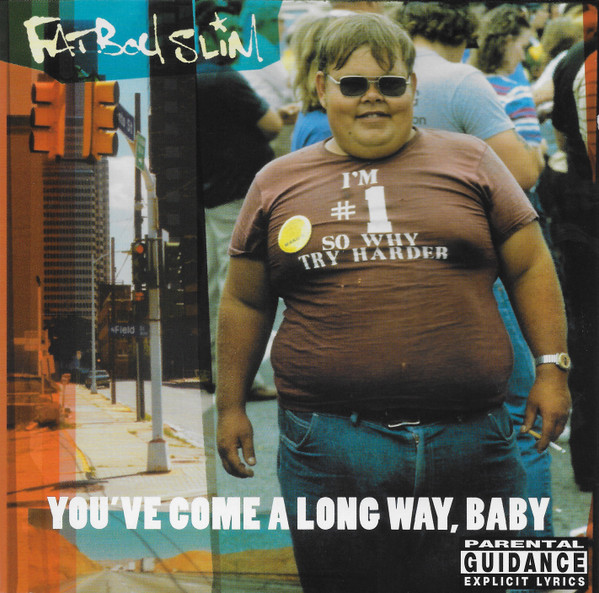
While I generally try to review only albums this month that may not be known by everybody and their mothers, I do have to pick one of the most iconic dance music albums of the 90s because of how much it means to me. So in a way it is less about the album but more about me.
I think you all agree with me that it’s impossible to think of the Big Beat movement of the 90s without instantly thinking of Fatboy Slim. Not sure if he actually started it, but he surely caused it to blow up. THE ROCKAFELLER SKANK was a huge crossover hit and in retrospect it’s remarkable that it became so iconic. We take it for granted now, but put it under a microscope: a cool but meaningless vocal sample that gets repeated over and over, breakbeats, surf guitars, that weird middle part with the loud sirens and constantly speeding up loop. None of that screams „worldwide top 40 hit that shows up in dozens of movies and TV shows“.
And yet here we are. It’s 2026 and if someone says „Right about now“, someone else will think or even say „The funk soul brother“.
Man, I was obsessed with that track. By that time my music taste really started to widen. I spent most of the 90s listening to House and Techno of varying quality (Let’s say „from Armand van Helden to Scooter“), so that was not completely out of my comfort zone. And by that time Radio Eins Live had every Saturday afternoon a four hour chart show. The last two hours were dedicated to the German Top 100, but the first two to were about the British. In retrospect I have no idea why they did that, but I am happy about it. Because the British charts of the 90s were insane in all the right ways. Not just because of how quickly a song could fall out of favour. They were dubbed „The fastest charts in the world“ because this week’s #1 song could be next week’s lower top 20 song. But what I really appreciated about them was the variety. German charts felt safe. Ultra commercial. Mostly thanks to a rule that said that a song needed a certain amount of airplay to enter the charts, no matter how well it sold. Thankfully that rule was abolished by 1997, but honestly, it didn’t make the German charts feel less safe. But the British charts? Oh damn, a cheesy pop song had the same chance to become a huge hit, like some weird and experimental „Is this still music?“ track. Never forget the story of how The Chemical Brothers’ SETTING SUN reached #1 despite not being played by BBC Radio. I found lots of cool independent and experimental music through the UK Charts.
I digress.
My point is: THE ROCKAFELLER SKANK was just the coolest shit ever. A good mood track. Aural happiness. If CDs could wear out, I probably would’ve rebought it at least two more times because of how many times I played the single in an endless loop. Even on a school trip to Berlin. My equally Fatboy Slim-obsessed buddy and me annoyed our roommates with it. And even more so with TWEAKERS DELIGHT, the bonus track that was actually just a DJ tool that consisted of a 303 bassline that got screechier and screechier, as you do with a 303. It was like the dance music of my previous youth, but also completely different.
And then came the next single: GANGSTER TRIPPIN’. Oh shit, that one made it clear that Fatboy Slim was for me! It was obvious that it wouldn’t be as big of a hit as ROCKAFELLER SKANK because it was just too weird. Like a Hip Hop instrumental gone beautifully wrong. But I loved it! I still remember the big, fat grin on my face when I heard it for the first time and how after a good 1 ½ minutes the track took a turn with a sample that sounded to me like a ukulele. (Turns out that it wasn’t, but that’s not important.)
Early on in my youth I became obsessed with sampling. The first time I heard this term was when DER BLONDE HANS, by a project named Hannes Kröger was a huge hit in the late 80s. It was a simple, early House track that used a bunch of snippets of dialogue from German actor Hans Albers. Obviously Fatboy Slim’s use of sampling was way more sophisticated than putting a few dialogue pieces over a drum machine beat. I sadly missed the boat on DJ Shadow’s ENDTRODUCING… until a few years later, but how here a whole bunch of samples were stacked on each other, lots of old music that was, to my uneducated teenage ears, absolutely uncool but in this combination was peak awesomeness, blew my fucking mind!
When the album finally came out, I instantly fell in love, as expected. But two of the most iconic tracks didn’t resonate with me at all for a while. I was pretty ambivalent about RIGHT HERE, RIGHT NOW and even remember skipping it many times. And I thought that PRAISE YOU was interesting but also kinda boring. When they were both released as singles, with incredibly rewatchable videos, they started to grow on me and by now I can’t imagine YOU’VE COME A LONG WAY, BABY without them.
Obviously I was more drawn to the more (in retrospect) typical Big Beat bangers on there, like BUILD IT UP – TEAR IT DOWN, SOUL SURFING or KALIFORNIA. My sister was quite offended by FUCKING IN HEAVEN. LOVE ISLAND was a bit of a grower for me, but it’s almost- House vibes won me over. And ACID 8000 was so strange and unusual that I just had to love it. To this day I think that YOU ARE NOT FROM BRIGHTON is the weakest track on there. It also grew on me, but it never fully clicked. ALWAYS READ THE LABEL, the B-side from THE ROCKEFELLER SKANK was kinda similar in style and vibe but worked better for me, so if I would be able to change one little thing, I would switch these two tracks. Or maybe replace BRIGHTON with SHO NUFF, which could be found on the single of PRAISE YOU.
I always half-jokingly call this long player „The CD that kept me sane during my last few years in school“. My teenage years weren’t exactly the happiest time of my life. Actually, neither were my preteen years. Or my adult years. Aw, fuck, I am such a sad bastard. Uhm. Anyway. I feel like for a good year I listened to this album every day, whenever I could. When I was at home, I was lying on my bed and listening to the CD, when I was going somewhere I had it copied on tape and listened on my walkman. I just knew (and still know) the whole thing by heart. Every beat, every sample.
In recent years I didn’t listen to it that much, out of fear that I overplayed it and wouldn’t enjoy it anymore. Also that it would probably bring back memories of the less happy times that I was blocking out with the good music. But no! YOU’VE COME A LONG WAY, BABY still works! It’s still one hell of a banger. A good time from the beginning to the end. I even appreciated YOU’RE NOT FROM BRIGHTON more this time.
To come back to me being a shameless Norman Cook fanboy: Shortly afterwards he released his mix CD ON THE FLOOR AT THE BOUTIQUE, which also had a huge impact on me. Most of all, coming from the era of pure rave music, 150-180 bpm Happy Hardcore bangers being mainstream, ON THE FLOOR actually impacted my DJing style. It not only taught me that it’s totally okay to drop old tracks in your set, even if they are not the instant floorfiller anthems that everybody loves, no, I even learned that a DJ can change genres within the same set! During the set on this CD we hear groovy 60s music, Hip House, Big Beat bangers, House tunes, Acid Techno, you name it! But I guess that was the credo of the Big Beat movement: Anything goes!
And maybe the biggest side effect of the one-two punch of A LONG WAY and ON THE FLOOR was that it got me into crate digging. I wanted to find out where these samples came from, which was, thanks to the availability of the internet through so-called „Internet cafes“, already doable. Although finding the names of the tracks was, of course, easier than finding the tracks themselves. But it took me on a journey through music that was maybe old but also really cool. So yeah, in a way you can say that much of my music taste was shaped in the late 90s.
And it all started with this album, which still holds up a lot.
A critic in my local newspaper said about it: „It’s no masterpiece, but it’s the album that you will play in the future if you wanna remember what 1998 sounded like.“
I disagree on the first part.