
There are no scarier words than „Now with new recipe“. Most of the time it means „You will never be able to enjoy your favourite food again“. It can be equally scary when a music act changes their style. But honestly, it doesn’t HAVE to be bad.
Sure, when Black Eyed Peas went from Hip Hop to Pop Rap to EDM, things worked out financially for them, but artistically they went from being pretty cool to being a laughingstock. And it was equally awkward when Korn released a Dubstep album, but thankfully that was a one-time thing.
On the other hand, Sparks have changed their style over the course of their long career quite a few times and always with great results. Underworld started out as an unremarkable Synthpop band until they became one of the greatest Techno acts ever! And once the German band Deichkind went from a pretty okay Hip Hop act to an unhinged Electropunk party band, they reached pure greatness.
Deichkind became a household name with their hit BON VOYAGE (Feat Nina MC) in 2000, but after that it seemed like they struggled to find their place in the scene. Back then, German Hip Hop was fun, funky, and lighthearted. It wasn’t all mindless party and pop rap, but it was a far cry from the gangsta rap that would dominate the scene for most of the 21st century. In theory, Deichkind 1.0 absolutely fit in but also maybe were a bit too out there. Was BON YOVAGE really just Hip Hop 101 (Well made, but mostly „We are the coolest, shake your ass to the beat“ lyrics without any real musical or lyrical spark), the follow-up KOMM SCHON is in retrospect a good representation of Deichkind’s true talent: Being a venn diagram between „really dumb“ and „actually pretty smart“. The lyrics can still be taken as typical Hip Hop bragging, but the video, that was shot in a swinger club and shows the band members in leopard print swim trunks and with 70s sunglasses and pornstaches, presenting their unflattering normal-looking bodies while being surrounded by topless models who adore them, makes it clear that they were making fun of certain rap cliches.
Their second album, NUR NOCH FÜNF MINUTEN MUTTI from 2002, only spawned one single. But it was one hell of a single! LIMIT was a party banger with electronic beats that were for that time really innovative. And the video was an instant classic. You don’t have to be a Deichkind superfan to point to the moment when everything changed. While LIMIT’s style seemed like a one-off thing, it surely sent ripples through the scene. It was quite the „love it or hate it“ thing. „Is this still Hip Hop?“ was a pretty often asked question.
But then came the big change. By 2005, Deichkind had stopped being Hip Hop. Was LIMIT a „Huh?“, E.S.D.B. was a big „What the fuuuuuuuuuuuuck!?“. Nothing about that was hip hop. The live drumbeat, the buzzing synths, the sung lyrics, the video that appeared to be a parody of art performances, all this was a mission statement. One that confused many people. On stage they started to wear outfits that were made of black garbage bags with neon duct tape. And in case it wasn’t clear yet that this was a style change for the band, they also appeared at the Mayday, Germany’s biggest indoor rave. The old Deichkind was dead, long live the new Deichkind.
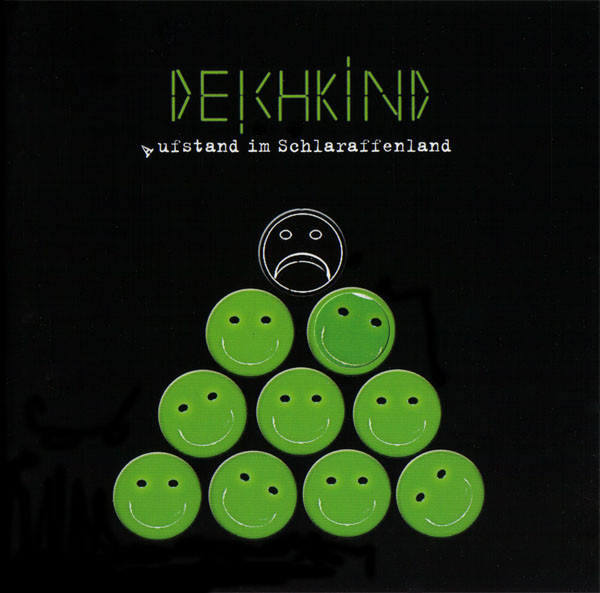
One should think that in 2006, when their new album AUFSTAND IM SCHLARAFFENLAND arrived, Germany had adjusted to the band’s new direction, but apparently that was not the case. Were the first two albums able to crack the top 20, was AUFSTAND only able to spend one single week at #68 before it dropped out of the album charts again. I do remember however that the reviews were pretty positive, although not overly enthusiastic.
And yes, it’s a good album. Compared to their later outputs, the music on AUFSTAND is pretty simplistic. Despite some clever touches, the melodies are minimalistic, the beats go boom, but rarely beyond that. But on a pure musical level it’s fun. A perfect party album with often hilarious lyrics. But this is where Deichkind 2.0 really score: Their lyrics often seem like mindless fun rap, often about getting drunk, but this is really only the surface. VOODOO is about someone who is pressured into taking drugs, the title track AUFSTAND IM SCHLARAFFENLAND is about consumerism and ICH BETÄUBE MICH seems like a typical „Nobody understands the kids of today“ scenario but is actually about an intervention.
Of course this long player isn’t only filled with Verhoeven-esque satire. REMMIDEMMI (YIPPIE YIPPIE YEAH) is a party song and now for 20 years the big closer at their completely unhinged live shows (I will go back to that in a minute). E.S.D.B. is basically a „This is who we are now“ announcement. And tongue in-cheek or not, PROST (feat Das Bo from Fünf Sterne Deluxe) is a „Let’s get hammered“ song.
For now good 20 years, Deichkind has been successfully walking the line between dumb party band and surprisingly profound lyricists. You hear their songs for the first time and laugh. Then you listen to them a second time and often think „Oh, I get it now“. They sure as hell don’t try to lecture their fans, but found a way that makes the message go down easier. Their concerts are Wild with a capital „W“. I saw them for the first time live in 2007, at a club as part of the Jägermeister Rock Liga, where every evening three bands competed against each other. The other two that night were T.Raumschmiere, who was quite psychedelic, and the Bloodhound Gang, who were the Bloodhound Gang. But by the end of Deichkind’s gig, the stage was filled with a bouncy castle, a man in a bunny costume on a pogo stick and a wild pillow fight. By now their concerts are even bigger and „I don’t like the band but still go to their concerts“ is by now pretty much a meme.
Would it be strange to call this album Deichkind’s PAUL’S BOUTIQUE? It’s maybe not as influential, although bands like ELECTRIC CALLBOY definitely took a page or two from the Deichkind playbook. It’s also not as innovative as PAUL’S BOUTIQUE. But both albums were misunderstood and failed to fully connect with most listeners on release, only to be retroactively praised. And both work as „This is who we really are and who we want to be as artists“ statements.